
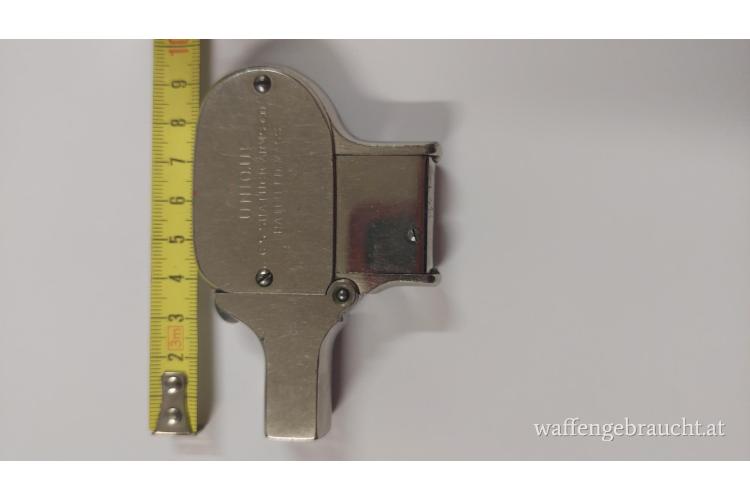
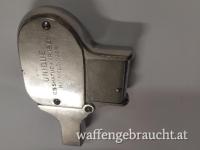
Biete extrem seltene Taschenpistole Unique C.S.Shatuck Arms Co Hatfield,Mass.


| Inseratnummer | 694027 |
| Preis | 850,00 € |
| wg_is_zwr_registered | 1 |
Beschreibung
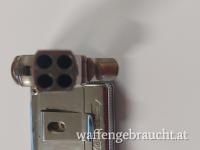
4 Läufige Taschenpistole im Cal.22LR mit Doubleaction Funktion und Rotationsschlagbolzen hergestellt zwischen 1907-1919
Es ist eines der vielen Mossberg Patente.
Die Pistole wurde verdeckt getragen und meist durch die Kleidung geschossen.
Die Anzahl der Waffen ist nicht genau bekannt zwischen 2000-3000 Stück diese hat die Nummer 605.
Kein gültiger Beschuss Sammlerwaffe! Nur mit gültiger WBK oder Pass Erwerbbar!
Die Waffe ist für Ihr über 100 Jähriges Alter in sehr gutem Zustand!
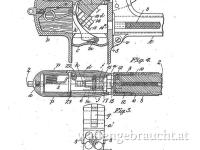
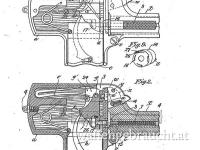
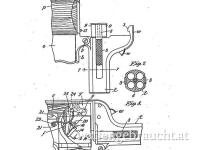
Hier ein Auszug aus der amerikanischen Geschichte mit Grafik in Englisch.
The Mechanics
These rimfire pistols are very small, with smooth bores, no ejectors, and a hinged barrel assembly released by a latch at the top of the backstrap, allowing for loading and unloading of the four chambers. Opening the action also facilitates the removal of an otherwise captive extraction pin made of flat sheet metal. This is used to push the spent cases from the chambers. It was easily lost and is often missing from surviving examples.
The pistols are almost always nickel plated. At the time, it was a popular protective finish for concealed carry pocket pistols, which are susceptible to corrosion from continuous exposure to sweat and moisture. The double-action trigger cycled an internal hammer to fire each barrel in succession. This was done by attaching to the hammer a rotating firing pin of the style first used by Christian Sharps in his popular four-barrel, single-action derringer made from 1859 to 1874.
The Unique pistols came in two frame sizes: small for the .22 rimfire (about 0.60″ thick) and a larger frame for the .32 rimfire that was about 12% bigger overall. They were comfortably designed, smooth on the exterior with rounded edges and contours for discreet concealed
carry, but that didn’t offer the shooter’s hand much purchase to control it during firing. One can imagine the danger posed to the thumb, forefinger and web of the hand if the pistol were imperfectly gripped. Well- made and reliable, this was nonetheless a highly specialized weapon with obviously limited practical applications and just terrible for people with sweaty hands. Who came up with this wacky idea?
Origin Story
The pistol was the first firearm invented and manufactured as a completely independent endeavor by future giant of the American firearms industry, Oscar F. Mossberg. At the time he received the patent for it in December 1906, he already had 15 years of firearms design and manufacturing experience and exceptional success in the area of improving the low-cost revolvers that New England was famous for at the turn of the century. His talents resulted in numerous patents for his employers.
He got his start at Iver Johnson Arms & Cycle Works from 1892 to 1900, then C.S. Shattuck Arms Co. from 1900 to 1902, the J. Stevens Arms & Tool Company from 1902 to 1916 were he got extensive experience in the design and manufacture of rifles and telescopic sights, and finally Marlin Rockwell from 1916 to 1919 were his wartime work centered around military machine guns including solutions for synchronizing the firing of aircraft guns so that bullets would not strike the propeller.
Between 1907 and 1909, Mossberg worked nights, weekends and holidays alongside his two high-school-aged sons, Iver and Harold, making his palm pistols. They produced the first 500 guns, all .22 rimfire, on secondhand machinery in the barn workshop he set up behind their modest home in Chicopee, Mass. The O.F. Mossberg & Sons we know today wouldn’t be incorporated until 1919, and his first guns bore no markings other than serial numbers.
Mossberg called it the Novelty pistol, but appears to have also used the name “The Invisible Defender” to market it. It must have made a positive impression on Mossberg’s friend and former employer Charles S. Shattuck because in 1909, Shattuck purchased the rights to make and sell the little pistol, dropping all his other gun product lines to focus on it. Rebranding the pistol as the “UNIQUE,” it is estimated Shattuck made between 2,000 and 3,000 over the next six years in .22, .32 and .30 rimfire chamberings, the latter being the rarest. These guns are easy to identify since they are stamped “UNIQUE/C.S. SHATUCK ARMS CO./HATFIELD, MASS.” Notice the missing letter “T.” Why a company in business since 1875 would allow its name to be misspelled on their premier product is open to speculation.
Not knowing the details of Shattuck’s personality, finances or business plans, his decision to drop his other firearms products and concentrate entirely on the Unique pistol looks like a risky move to me. Maybe it was a “Hail Mary” play to save his company. Whatever the circumstances were, the company went under. In 1915, they were placed in receivership, and American production of the Unique ended for good. Curiously, in 1916 another U.S. patent was awarded to Cornelius Vanderbilt, Jr. for a pistol of the same design, but there is no evidence this blatant patent violation ever went into production. Nor did Mossberg himself ever resume production of the pistol. I suspect this was because he didn’t see a future in it. It was really too novel to be widely practical.
Keine Garantie wie Rücknahme da Privatverkauf
TEL.0650 700 1107
HERR Gero
Es ist eines der vielen Mossberg Patente.
Die Pistole wurde verdeckt getragen und meist durch die Kleidung geschossen.
Die Anzahl der Waffen ist nicht genau bekannt zwischen 2000-3000 Stück diese hat die Nummer 605.
Kein gültiger Beschuss Sammlerwaffe! Nur mit gültiger WBK oder Pass Erwerbbar!
Die Waffe ist für Ihr über 100 Jähriges Alter in sehr gutem Zustand!
Hier ein Auszug aus der amerikanischen Geschichte mit Grafik in Englisch.
The Mechanics
These rimfire pistols are very small, with smooth bores, no ejectors, and a hinged barrel assembly released by a latch at the top of the backstrap, allowing for loading and unloading of the four chambers. Opening the action also facilitates the removal of an otherwise captive extraction pin made of flat sheet metal. This is used to push the spent cases from the chambers. It was easily lost and is often missing from surviving examples.
The pistols are almost always nickel plated. At the time, it was a popular protective finish for concealed carry pocket pistols, which are susceptible to corrosion from continuous exposure to sweat and moisture. The double-action trigger cycled an internal hammer to fire each barrel in succession. This was done by attaching to the hammer a rotating firing pin of the style first used by Christian Sharps in his popular four-barrel, single-action derringer made from 1859 to 1874.
The Unique pistols came in two frame sizes: small for the .22 rimfire (about 0.60″ thick) and a larger frame for the .32 rimfire that was about 12% bigger overall. They were comfortably designed, smooth on the exterior with rounded edges and contours for discreet concealed
carry, but that didn’t offer the shooter’s hand much purchase to control it during firing. One can imagine the danger posed to the thumb, forefinger and web of the hand if the pistol were imperfectly gripped. Well- made and reliable, this was nonetheless a highly specialized weapon with obviously limited practical applications and just terrible for people with sweaty hands. Who came up with this wacky idea?
Origin Story
The pistol was the first firearm invented and manufactured as a completely independent endeavor by future giant of the American firearms industry, Oscar F. Mossberg. At the time he received the patent for it in December 1906, he already had 15 years of firearms design and manufacturing experience and exceptional success in the area of improving the low-cost revolvers that New England was famous for at the turn of the century. His talents resulted in numerous patents for his employers.
He got his start at Iver Johnson Arms & Cycle Works from 1892 to 1900, then C.S. Shattuck Arms Co. from 1900 to 1902, the J. Stevens Arms & Tool Company from 1902 to 1916 were he got extensive experience in the design and manufacture of rifles and telescopic sights, and finally Marlin Rockwell from 1916 to 1919 were his wartime work centered around military machine guns including solutions for synchronizing the firing of aircraft guns so that bullets would not strike the propeller.
Between 1907 and 1909, Mossberg worked nights, weekends and holidays alongside his two high-school-aged sons, Iver and Harold, making his palm pistols. They produced the first 500 guns, all .22 rimfire, on secondhand machinery in the barn workshop he set up behind their modest home in Chicopee, Mass. The O.F. Mossberg & Sons we know today wouldn’t be incorporated until 1919, and his first guns bore no markings other than serial numbers.
Mossberg called it the Novelty pistol, but appears to have also used the name “The Invisible Defender” to market it. It must have made a positive impression on Mossberg’s friend and former employer Charles S. Shattuck because in 1909, Shattuck purchased the rights to make and sell the little pistol, dropping all his other gun product lines to focus on it. Rebranding the pistol as the “UNIQUE,” it is estimated Shattuck made between 2,000 and 3,000 over the next six years in .22, .32 and .30 rimfire chamberings, the latter being the rarest. These guns are easy to identify since they are stamped “UNIQUE/C.S. SHATUCK ARMS CO./HATFIELD, MASS.” Notice the missing letter “T.” Why a company in business since 1875 would allow its name to be misspelled on their premier product is open to speculation.
Not knowing the details of Shattuck’s personality, finances or business plans, his decision to drop his other firearms products and concentrate entirely on the Unique pistol looks like a risky move to me. Maybe it was a “Hail Mary” play to save his company. Whatever the circumstances were, the company went under. In 1915, they were placed in receivership, and American production of the Unique ended for good. Curiously, in 1916 another U.S. patent was awarded to Cornelius Vanderbilt, Jr. for a pistol of the same design, but there is no evidence this blatant patent violation ever went into production. Nor did Mossberg himself ever resume production of the pistol. I suspect this was because he didn’t see a future in it. It was really too novel to be widely practical.
Keine Garantie wie Rücknahme da Privatverkauf
TEL.0650 700 1107
HERR Gero
Kontakt
| Name | Gero |
|---|---|
| Mitglied seit | August 2014 |
| Plz, Ort | 1110 Wien |
| Land | Österreich |